SEC. 201. PROTECTED NASA FUNDING FLOOR.
(a) Beginning not later than FY2029, NASA shall receive annual budget authority of not less than 300 percent of its certified FY2025 discretionary baseline in real dollars.
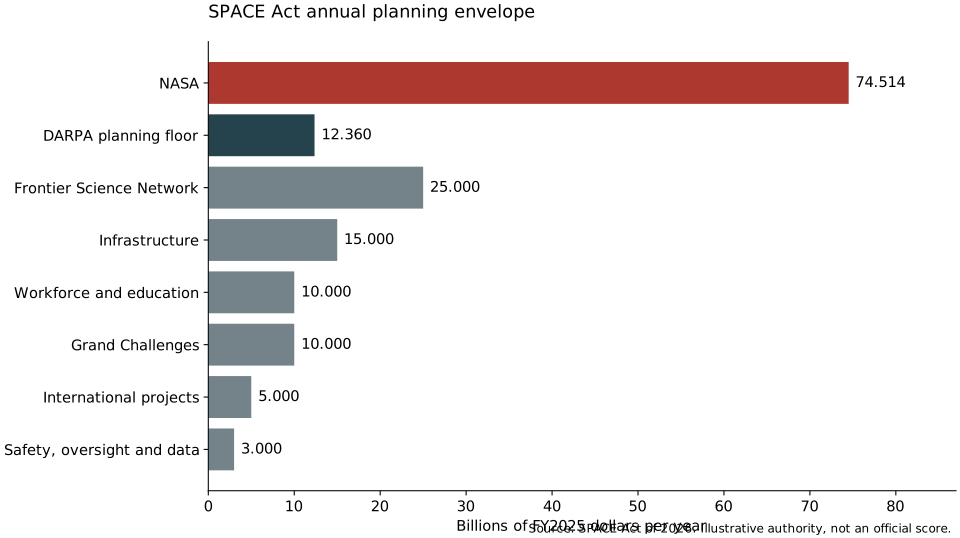
(b) For planning before certification, the FY2025 NASA discretionary baseline is $24,838,000,000, corresponding to a 3x planning floor of $74,514,000,000.
(c) The minimum multiple is 1.75 in FY2027, 2.50 in FY2028, and 3.00 in FY2029 and thereafter.
(d) One-time FY2025 disaster or mandatory appropriations shall not inflate the recurring baseline unless the certification process determines that the amounts represented recurring operating capacity.
SEC. 202. PROTECTED DARPA FUNDING FLOOR.
(a) Beginning not later than FY2029, DARPA shall receive annual budget authority of not less than 300 percent of its certified FY2025 enacted RDT&E baseline in real dollars.
(b) For initial planning only, $4,120,000,000 shall be used pending certification, corresponding to a 3x planning floor of $12,360,000,000.
(c) The minimum multiple is 1.75 in FY2027, 2.50 in FY2028, and 3.00 in FY2029 and thereafter.
(d) Not less than 70 percent of DARPA budget authority shall support technical programs, performers, test, validation, transition, and direct program-management support rather than permanent headquarters overhead.
SEC. 203. FRONTIER SCIENCE NETWORK ACCOUNT.
(a) A Frontier Science Network Account is established with an illustrative steady-state minimum of $25,000,000,000 in FY2025 real dollars.
(b) Eligible institutions include NSF, DOE Office of Science and national laboratories, NIST, NOAA research laboratories, selected NIH and ARPA-H cross-cutting programs, USGS science functions, and other Federal scientific entities designated by law.
(c) Funds shall supplement ordinary appropriations and prioritize basic research, shared instruments, scientific software, metrology, data, early-stage technical work, and cross-agency capability gaps.
(d) No participating agency shall be required to adopt DARPA-style program management where investigator-led peer review, long-duration observation, or facility science is more appropriate.
SEC. 204. SCIENTIFIC INFRASTRUCTURE ACCOUNT.
(a) A Scientific Infrastructure Account is established within the Fund with an illustrative steady-state authority of $15,000,000,000 in FY2025 real dollars.
(b) Eligible costs include planning, land, environmental review, design, construction, equipment, maintenance, recapitalization, utilities, cyber infrastructure, test facilities, field stations, housing at remote sites, and decommissioning reserves.
(c) Major facilities require full lifecycle cost and workforce plans before construction obligations exceed 20 percent of estimated total project cost.
SEC. 205. WORKFORCE AND EDUCATION ACCOUNT.
(a) A Workforce, Education, and Mobility Account is established with an illustrative steady-state authority of $10,000,000,000 in FY2025 real dollars.
(b) Funds may support scholarships, fellowships, apprenticeships, recruitment, special pay, relocation, childcare, housing assistance, teacher programs, university partnerships, community colleges, scientific exchanges, and technician training.
SEC. 206. INDEXING AND REAL-DOLLAR PRESERVATION.
(a) OMB shall calculate annual real-dollar adjustments using the GDP chain-type price index unless Congress adopts a research-cost index recommended by the President.
(b) OMB shall publish the index, base year, methodology, and resulting statutory floors at least 120 days before each fiscal year.
(c) A technical index change may not be used to reduce real purchasing power.
SEC. 207. BASELINE CERTIFICATION AND AUDIT.
(a) Within 90 days after enactment, OMB, NASA, and the Department of Defense Comptroller shall certify FY2025 baselines under transparent accounting rules.
(b) GAO shall review the certification within 60 days and identify any treatment of transfers, rescissions, supplementals, unobligated balances, or mandatory appropriations that materially changes recurring capacity.
(c) Certified amounts supersede planning figures without further amendment.
SEC. 208. DESIGNATION OF ADDITIONAL COVERED INSTITUTIONS.
(a) Congress may designate additional covered frontier institutions and provide institution-specific funding floors.
(b) The President may recommend designations based on mission distinctiveness, public-good characteristics, high-risk or long-horizon need, governance quality, and insufficiency of ordinary funding pathways.
(c) No executive designation alone creates a mandatory funding floor.
SEC. 209. AVAILABILITY OF FUNDS.
(a) Basic and applied research accounts shall ordinarily remain available for five fiscal years.
(b) Major facility, spacecraft, instrument, test infrastructure, compute, and construction accounts shall remain available until expended, subject to milestone review.
(c) Programs shall not be forced into artificial year-end expenditures merely to prevent expiration when multiyear authority is lawfully available.
SEC. 210. ANTI-SUPPLANTING AND ANTI-RAIDING.
(a) Protected SPACE funds may not be counted as satisfying an unrelated reduction in a recipient agency's ordinary scientific baseline.
(b) Transfers from civilian scientific accounts to defense accounts, or the reverse, require express statutory authority except for jointly approved projects with documented cost shares.
(c) No agency may use the Fund as a reason to cancel ordinary maintenance, scientific computing, or workforce appropriations otherwise necessary for core operations.
SEC. 211. EXECUTION-CAPACITY SAFEGUARD.
(a) Before annual funding growth above 25 percent, an institution shall publish an execution-capacity plan covering staffing, contracting, facilities, risk controls, project management, and expected obligation timing.
(b) Unexecuted capacity shall be carried forward or shifted among eligible portfolios rather than forcing low-quality year-end spending.
SEC. 212. REPROGRAMMING AND PORTFOLIO FLEXIBILITY.
(a) Within a portfolio, up to 15 percent may be reprogrammed among technical approaches without prior approval, subject to notice above 7.5 percent.
(b) No reprogramming may violate an express statutory prohibition or transfer resources between agencies without authority.
(c) This section permits technical adaptation without converting broad appropriations into unreviewable discretion.