Dignity
Dependable water, food, energy, healthcare, learning and personal security wherever people live.

A shared civic future
A proposed democratic federation of consenting nations, with equal membership and a shared floor of rights.
Proposal for public deliberation · No federation established
One human community
One World is True Tomorrow’s proposal for a democratic federation of consenting nations: full member standing, accountable common institutions and a shared floor of rights and essential services. A common civic identity would sit alongside national, regional and local identities.
The vision brings the European Union’s experience of pooled sovereignty into conversation with the United States’ constitutional division of powers. Both offer lessons; neither can simply be copied at planetary scale. A future constitution would need to be debated, chosen and ratified by the peoples and states it serves. Institutional references ↓
A proposal for public deliberation. No federation, sovereign consent or operating program is established by this page. The Foundation can research, convene and propose; governing authority belongs to people and law.
Dependable water, food, energy, healthcare, learning and personal security wherever people live.
Full standing for participating nations and fair representation for the people within them.
Public authority grounded in consent, elections, independent justice and enforceable rights.
Many languages, cultures and ways of life, with the freedom to question the shared project.

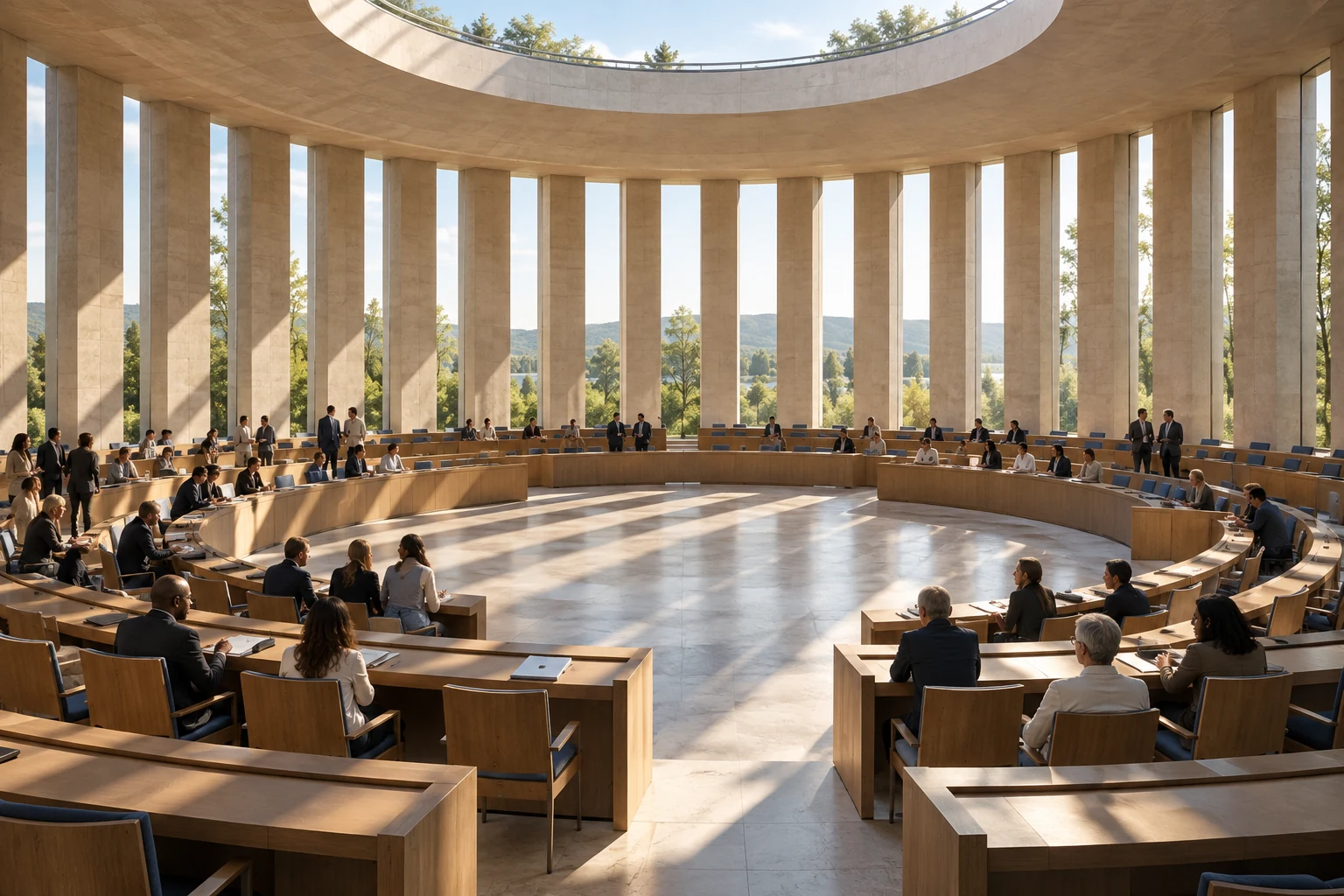
The stones in this imagined assembly keep their own shape. Their connection creates a shared space without erasing their differences. One World asks whether common institutions could do the same for people and nations, through consent, limited powers and a protected right to disagree.
The proposed next chapter
Before any constitutional pathway, the work is to publish choices, examine tradeoffs and build practical cooperation that people can accept or decline.
Shared authority must earn its legitimacy.
Priorities for developmentCross-border problems do not justify unlimited central authority. Representation brings real tensions between population and equal national standing.
Develop competing options for enumerated powers, representation, independent justice, emergency limits and amendment. Stress-test them with the interests of small nations, minorities and dissenting communities in view.
Clarity of powers, accessibility of review and the quality of public reasoning. Publish unresolved disagreements rather than presenting a single model as inevitable.
Incompatible qualifications and service rules can restrict people’s choices even when neighbouring institutions want to cooperate.
Propose voluntary recognition and portability agreements with fair support for receiving communities and sufficient local capacity. State which protections travel with a person and who remains responsible.
Usable rights, administrative burdens and service continuity. Lower migration totals are not a measure of success, and participation must remain voluntary.
Civic education can become advocacy disguised as instruction when success is measured by political support.
Develop independently reviewed materials that present federation, alternatives and objections. Publish funding and authorship, support local-language access and protect independent educators.
Understanding, critical reasoning and access to competing perspectives. Never measure political loyalty or condition essential assistance on agreement.
Advance when the conditions are met. These are proposed stages, not announced projects or deadlines.
Publish a constitutional options paper and an explicit register of unresolved choices, including representation, limits on power and the rights of people who dissent.
Explore practical service, research and recognition agreements. Each should state its obligations, dispute process and conditions for ending participation.
Any deeper authority would require lawful democratic authorization. Constitutional review, amendment and withdrawal must protect acquired rights and shared obligations.
The One World Gift remains separate: a proposed $1 trillion annually for 30 years, with no governing authority attached. Essential assistance must never depend on membership or political agreement.
A proposed constitutional structure
Legitimacy has more than one source. The design must give people a meaningful vote, protect smaller member nations and keep every branch of government answerable.
The framework above every office, including those that administer it.
Directly elected representation based on population, with a public apportionment rule and protection against disenfranchisement.
Equal standing for full member nations. Major constitutional changes require both popular and member-state consent.
Time-limited elected or parliamentary leadership, public budgets, legislative oversight and removal under law.
Enforceable rights, accessible remedies and review of common powers, supported by transparent appointments and judicial independence.
This is a proposed architecture. Apportionment, voting thresholds, executive selection and court appointments remain questions for an open constitutional process. No formula removes every tension between population and member-state equality.
The division of responsibility
Make decisions close to the people affected. Share authority when a shared problem needs it.
All levels remain bound by the common rights floor.
Common authority must be explicitly granted, necessary and proportionate. Any future common fiscal or security powers require separate democratic authorization, defined limits and public oversight. The gift creates no such powers.
The vision becomes a gift
Equal opportunity begins with material foundations: dependable essentials, capable public systems and the freedom to shape a future in your own community.
One World Gift · Founding proposal
$30trillion$1 trillion a year.
For 30 years.
A proposed, fully private gift would begin where deprivation and exposure to harm are greatest: clean water and sanitation, healthy air, food, reliable energy, education, healthcare, climate resilience and local income security.
Assistance and constitutional membership are independent. People and places remain eligible regardless of their view of One World. A school, clinic or water system is never a payment for political consent.
The proposed $30 trillion is a fixed nominal commitment, separate from the $50 trillion American Vision. Funding, donor commitments and operational impact have not been verified.
 Water in commonOriginal sculpture · Blender
Belonging without erasure
Make home a place of safety and possibility. Protect asylum, family life and voluntary movement. Shared belonging should widen the choices available to a person.
Development can increase people’s ability to migrate. Lower migration totals are not the measure of success. Gradual removal of border barriers would depend on democratic agreements, portable services and fair support for receiving communities.
Read the mobility principles
A shared civic life
Learn to cooperate.
Keep the freedom to disagree.
A common future needs informed citizens who can examine it for themselves.
Education would connect human rights, local and global institutions, climate and health interdependence, media literacy and peaceful conflict resolution. It would examine the advantages, risks and alternatives to federation through evidence and debate.
Teachers, independent educators and communities would co-design open materials in local languages, protecting Indigenous knowledge and age-appropriate learning. Publish the curriculum and its funding. Protect competing perspectives and applicable education rights.
The Gift proposes up to $5 billion annually within its $30 billion institutions envelope for civic learning, exchange and deliberation. It is part of the same $1 trillion annual budget. Measure knowledge and critical reasoning; never political loyalty.
Explore the education safeguardsUNESCO’s education recommendation offers a reference for this approach; it does not endorse the Foundation’s proposed federation.
A pathway built on consent
Earn trust.
Build capability.
Choose what comes next.
Integration follows demonstrated readiness and democratic choice. The Gift’s 30-year horizon is not a deadline for political union, and delivery can continue wherever further integration is declined.
Begin with locally led service, research and infrastructure compacts. Assistance follows need and never requires political agreement.
Develop reciprocal standards, recognized qualifications, portable protections and common responses to cross-border risks.
Pursue regional mobility and constitutional deliberation where democratic consent, rights protections and public institutions are ready.
Establish common authority through lawful ratification. Review its powers, results and legitimacy, with a constitutional route to amendment and withdrawal.
Membership requires rights protections and administrative readiness, never cultural sameness. Transitional support responds to need; the destination is full membership, with no permanent first- and second-class nations.
The terms of a shared future
These are proposed limits on funding, partnership, education and institutional conduct.
Access to food, water, care, schooling and other essential services never depends on federation membership, civic participation or political belief. Unaffiliated nations remain eligible for assistance.
Protect languages, Indigenous knowledge, religious freedom and local institutions, subject to an enforceable common floor of human rights. Equal membership does not demand cultural sameness.
An independent philanthropic board stewards the proposed gift. Public institutions gain governing authority from people and law. The donor receives no appointment rights over a federation, immunity from scrutiny or power to override beneficiaries’ rights.
People can reject the vision, organize peaceful opposition, seek independent remedies and challenge public decisions without losing services. Civic education measures understanding and reasoning, never loyalty.
Common powers must be explicitly conferred and proportionate. Emergency authority expires unless lawfully renewed; courts review its use. A lawful withdrawal process protects acquired rights and settles shared obligations.
Evidence and open questions
The constitutional architecture is a Foundation proposal. These sources inform its design and constraints; their institutions have not endorsed it.
Conferral, subsidiarity, democratic representation, accession and withdrawal.
A constitutional division of legislative, executive and judicial authority.
Sovereign equality, self-determination and peaceful cooperation.
Migration, development and the responsibilities of origin and destination societies.
A reference for global civic learning, critical reasoning and intercultural understanding.