people without safely managed drinking water [N01]
2024 · WHO/UNICEF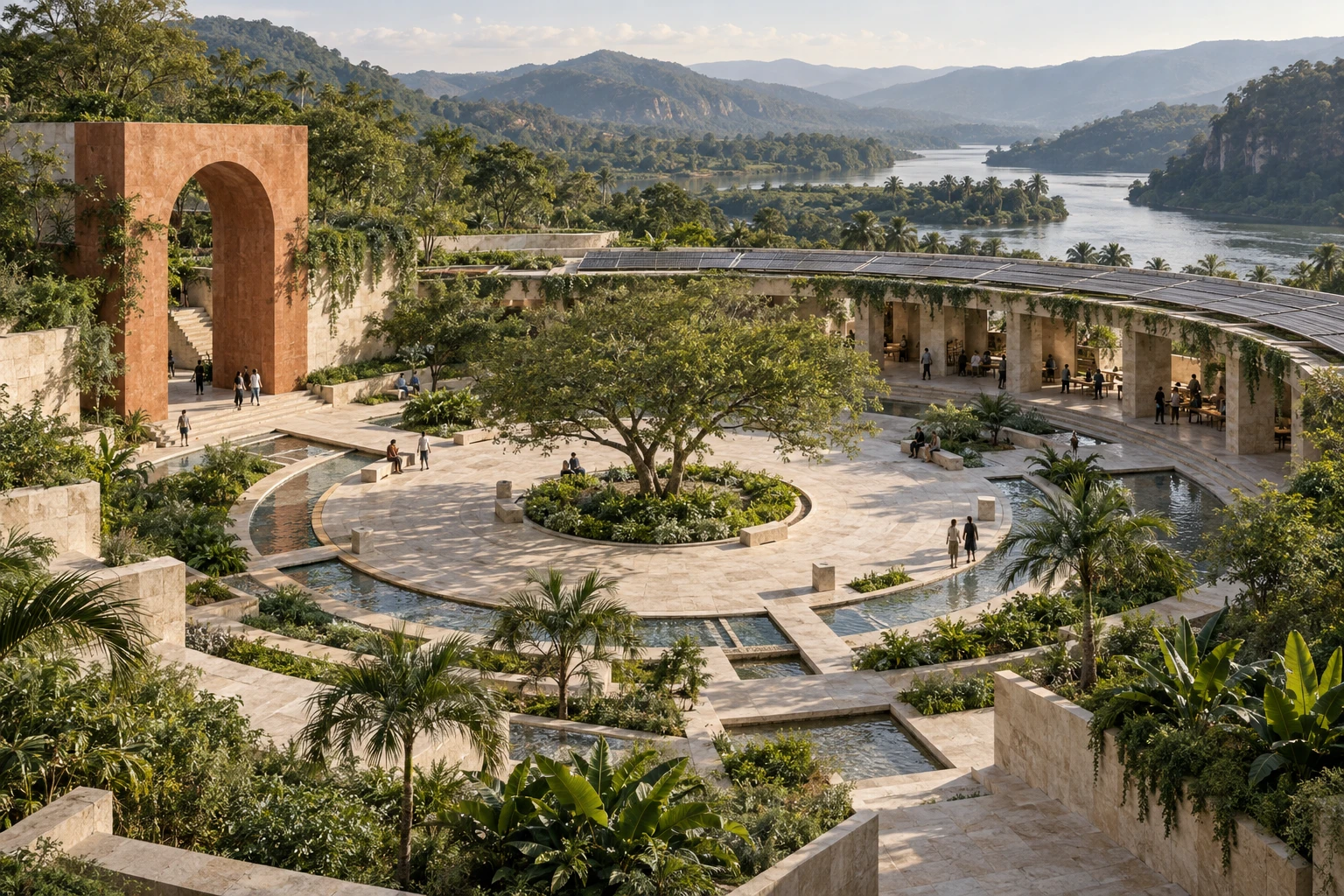
The Gift to humanity
$30 trillion.A gift to humanity.
A proposed $1 trillion a year for 30 years, beginning where the need is greatest.
Founding proposal · Funding not verified · Fixed nominal US dollars
01 / the gift
A good life should not depend on where it begins.
The proposed gift prioritizes people facing severe deprivation, conflict, disease, and climate disruption. It joins immediate relief with lasting public services and local capability.
The ambition is convergence: communities everywhere gaining access to the quality of essential services and opportunity associated with highly developed societies. Local cultures, languages and democratic choices remain their own. Universal dignity does not require identical ways of life.
This is a separate proposal from the Foundation’s $50 trillion American Vision. Neither fund may count the same award twice. Global eligibility is based on unmet need, including underserved communities in wealthier countries where justified; the largest unmet needs take priority.
Help is a right of the recipient, never a purchase of allegiance.
Access to food, water, healthcare or schooling cannot depend on accepting the One World vision, attending civic activities, changing religion, or supporting any political position.
02 / the need
A world of extraordinary possibility. Still denied the essentials.
people estimated to face hunger [N02]
2025 · FAO and partnerspeople without electricity [N05]
2024 · SDG7 custodianschildren and young people out of school [N06]
2024 · UNESCOpeople lacking essential health-service coverage [N03]
2023 · WHO / World Bankannual developing-country adaptation needs by 2035 [N08]
2023 prices · UNEP 2025Different populations, definitions and reference years. These figures overlap; they must not be added together. Need estimates are evidence, not predictions of what this gift will achieve.
The financing challenge is larger than any single donor. ILO estimates a roughly $1.4 trillion annual gap for a social protection floor in low- and middle-income countries alone, including essential healthcare. That estimate overlaps this proposal’s sectors and is not an additional bill to add to them. [N13]
The practical response is a catalytic, long-horizon gift: strengthen public systems and local economies, protect those left behind, and build durable domestic financing. Do not promise the end of all poverty on a fixed date.
03 / annual plan
One trillion. A whole life.
Every annual dollar has a purpose. This is an illustrative planning allocation, not an independently costed promise of universal coverage. Local evidence, prices and delivery capacity would determine actual awards.
01Water, sanitation & hygiene11% $110B11%Details
Safe water at home, dignified sanitation, and functioning water systems in every school and clinic.
Protect catchments; test and treat supplies; repair networks; build appropriate rural systems; manage fecal sludge and wastewater; provide menstrual hygiene and accessible toilets. Fund operators, spare parts, source monitoring and affordable service.
Measure what changes. Safely managed drinking water and sanitation, water quality, continuity, affordability, and collection time — not pipes installed.
Water infrastructure is booked here; a clinic’s clinical services remain in health. Desalination requires a viable energy, brine and maintenance plan.
02Food security & resilient agriculture12% $120B12%Details
Reliable access to nutritious food, supported by farmers and local markets that can withstand shocks.
Treat acute malnutrition, support maternal and early-childhood nutrition, provide locally sourced school meals, use cash when markets function, and supply food when they do not. Build storage, cold chains, extension, soil health and climate-appropriate irrigation.
Measure what changes. Food insecurity, diet affordability, child wasting and stunting, post-harvest loss, and smallholder net income.
No land acquisition that removes customary rights; no blanket export dumping. School meals are recorded here rather than counted again in education.
03Healthcare, medicines & care19% $190B19%Details
Accessible, quality essential care without financial hardship.
Build primary-care networks and referral systems; train, pay and retain local health workers; support maternal, newborn, reproductive, mental, disability and older-person care; chronic-disease treatment, rehabilitation, palliative care, vaccination, diagnostics, quality-assured essential medicines, emergency services and disease surveillance.
Measure what changes. Effective coverage, preventable mortality, medicine stockouts, referral times, quality and household financial hardship.
Care packages follow local burden, WHO guidance and health-technology assessment. Do not fund buildings without staff, operating budgets, supply chains and infection control.
04Clean energy & breathable air14% $140B14%Details
Dependable, affordable power and clean cooking, with lower exposure to dangerous pollution.
Least-cost grids, mini-grids and stand-alone systems; storage and regional interconnection; clinic and school power; clean cooking with sustained fuel affordability; air monitoring, cleaner transport and industrial emissions control.
Measure what changes. Reliability, affordability, useful electricity capacity, sustained clean-cooking use and population-weighted particulate exposure.
A connection alone is not reliable service. Count household fuel use after adoption; prevent a nominal clean stove from masking continued polluting use.
05Education, skills & public knowledge15% $150B15%Details
A complete learning pathway, from early childhood through adulthood.
Free, accessible primary and secondary education; early learning; qualified teachers; language-appropriate foundational learning; inclusive curricula; libraries; digital access; vocational training; tertiary scholarships; research capacity and adult literacy.
Measure what changes. Learning, completion and transition, teacher retention, inclusion and meaningful employment — not enrollment alone.
Protect local languages and cultures. Global civic learning is financed within the institutions portfolio; schools retain independent educational oversight.
06Homes, income security & infrastructure11% $110B11%Details
Safe places to live, move, communicate and earn a livelihood.
Plan $25B within this envelope for predictable, locally designed income support for poor households, children, disabled people and older people, linked to sustainable social protection systems. Use the remaining $85B to upgrade informal settlements without forced displacement; support safe affordable housing; repair access roads, transit, drainage and accessible public space; and provide affordable connectivity.
Measure what changes. Predictability and adequacy of income support, housing safety and tenure security, affordability, travel time, connectivity and climate downtime.
Favor upgrades and maintenance before prestige construction. Separate this enabling infrastructure from water and power assets in those portfolios.
07Climate resilience & living systems8.5% $85B8.5%Details
Communities prepared for heat, drought, floods, storms and ecosystem loss.
Early-warning systems tied to action; heat-health plans; resilient coasts and watersheds; ecosystem restoration with Indigenous stewardship; climate information, adaptation planning, and consent-based relocation where protection is no longer viable.
Measure what changes. People protected by actionable warnings, resilience of essential services, avoided exposure and ecosystem health.
Dedicated adaptation and nature spending sits here. Climate benefits in other portfolios are tagged, never added a second time to the $1T total.
08Local institutions & shared civic life3% $30B3%Details
Public institutions people can use, question and help govern.
Plan $15B for local public administration and service accountability; $10B for legal access, independent public-interest knowledge and participatory budgeting; up to $5B for pluralist global civic education, exchange and deliberation.
Measure what changes. Complaint resolution, representative participation, access to justice, civic knowledge and trust measured independently.
The $5B civic component is inside this $30B envelope. No tests of political agreement, party campaigning, donor promotion or aid conditional on joining One World.
09Humanitarian protection & displacement4% $40B4%Details
An immediate lifeline in conflict, disaster and forced displacement.
Protection, emergency shelter, multi-purpose emergency cash, continuity of services, humanitarian logistics, and support shared fairly between displaced people and host communities.
Measure what changes. Timeliness, unmet urgent needs, safe access, service continuity and protection outcomes.
Sector-specific emergency health, food and water are charged to their respective portfolios. This envelope covers protection and cross-sector coordination without duplicate claims.
10Independent integrity, evidence & remedy1% $10B1%Details
Public proof of where money went and whether lives improved.
Independent audit, evaluation, secure reporting, open contracting, ombuds services, investigations, accessibility review and remedy. Publish uncertainty and negative results.
Measure what changes. Verified outcomes, resolved complaints, procurement integrity, timeliness of reporting and recovery of misused funds.
This is a 1% central oversight planning allowance, not a claim that all delivery overhead fits within 1%. Portfolio budgets include disclosed partner and operating costs.
11Unallocated contingency1.5% $15B1.5%Details
Capacity to respond to needs that a fixed annual plan cannot foresee.
Hold against emergencies and verified cost shocks. Allocation requires a published decision and beneficiary-protection review; transfer to one receiving portfolio only.
Measure what changes. Reconciled balances, reasons for release and resulting public benefit.
A held reserve is not a service delivered. It is separate from the liquidity buffer and temporarily unspent program commitments.
All 11 envelopes sum to $1,000B a year and $30,000B over 30 years. Climate, gender, disability and local leadership are cross-cutting tags, not extra pots. Delivery partners’ administration and maintenance are included in each sector; the $10B integrity line is independent oversight. Reserves and undisbursed balances are reported separately from services delivered.
Download the allocation ledger (CSV)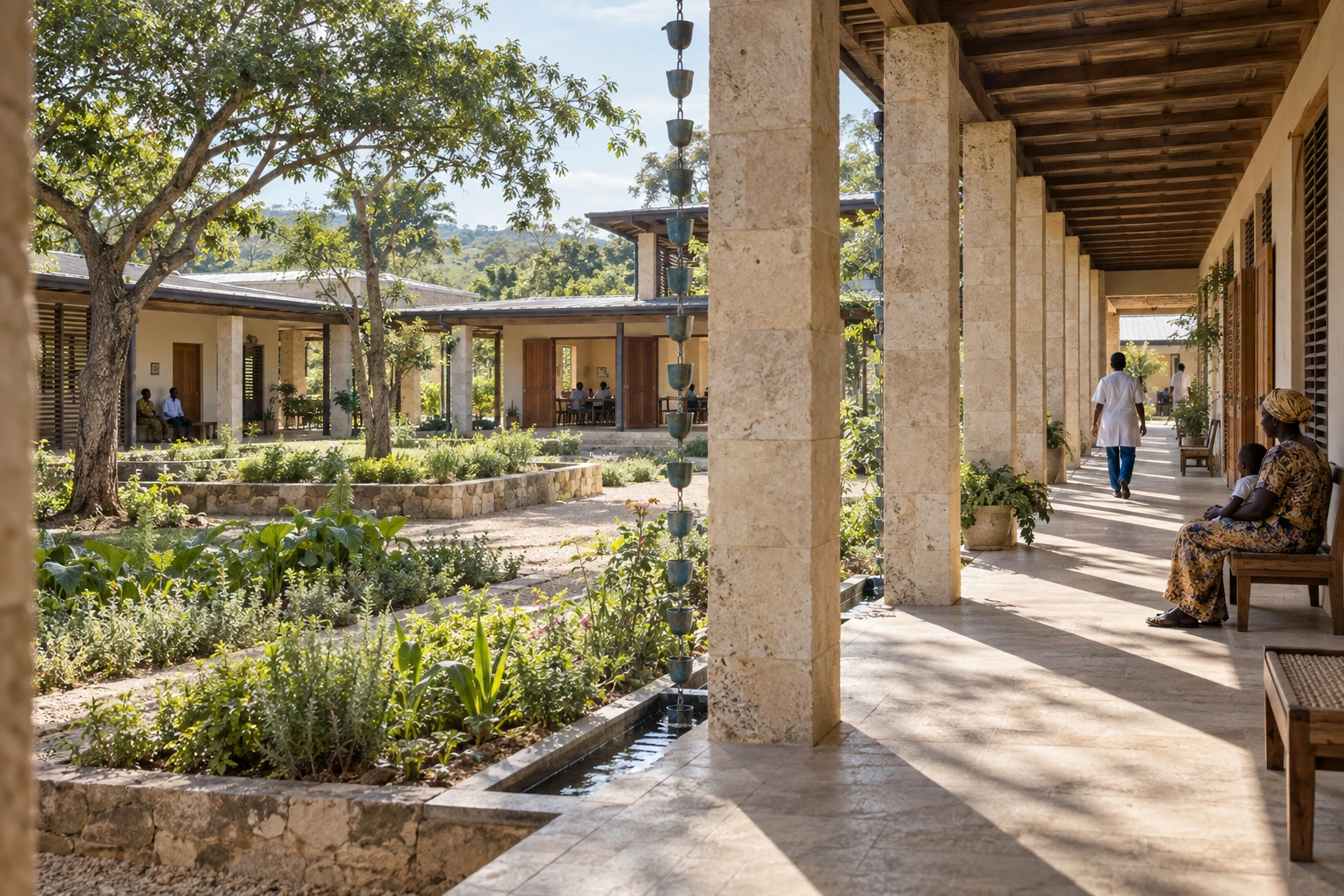
One connected public system
A clinic is more
than a building.
It needs clean water, dependable power, trained people, medicines and a route that patients can reach. The Gift plans these services together.
$190Bproposed annually for
healthcare, medicines and care
See the service benchmarks healthcare, medicines and care
Conceptual artwork, not an operating Foundation facility.
Funding assumptions & purchasing power
04 / funding durability
Thirty payments. A promise built to last.
$30 trillion means $30 trillion. The base design is 30 fixed nominal payments of $1T. It assumes no investment earnings, borrowing, public co-funding or inflation top-up. The first payment date will be set only after legal and financial readiness.
That year’s $1T in year-one purchasing power$424B
At 3% inflation, protecting $1T of annual purchasing power would require $47.58T in nominal gifts over 30 years.
Illustrative constant inflation, not a forecast. Real purchasing power in year y = $1T ÷ (1 + inflation)y−1. Local costs, exchange rates and sector inflation differ. Wolfram verified the underlying sums; see the finance note.
How the funding promise becomes credible
Execute a legally enforceable, independently governed gift agreement. Verify the donor’s ownership, liquid resources, collateral, liabilities and source of funds; stress-test solvency and currency exposure. A pledge is not cash. Thirty annual transfers are not the same as $30T already held in trust.
Build a 24–36 month forward liquidity buffer for specified essential operating obligations, not the entire $1T annual plan. Validate this buffer before each award and throughout handoff; the illustrative cash-flow schedule alone does not prove compliance. Keep this buffer within available resources, held in short-duration, high-quality liquid instruments matched to obligations. Do not expand recurring commitments before the buffer and enforceable funding support exist. Segregate custody, investment decisions, grant approval and audit.
The illustrative present value of 30 year-end payments of $1T is $30T at 0% net return, $22.40T at 2%, $17.29T at 4%, or $13.76T at 6%. These are constant-return arithmetic scenarios, not safe funding levels or return forecasts. Tax, fees, default, volatility, timing and sequence risk matter; equities cannot guarantee annual grants.
Vehicle-specific payout rules may require a different distribution schedule. A US nonoperating private foundation generally calculates minimum investment return from 5% of adjusted noncharitable-use assets; $1T is only 3.33% of a $30T starting asset base. These arithmetic cases are not approved legal structures. [G12] [G13]
The illustrative zero-return release schedule starts at $350B, $550B, $750B and $900B in years 1–4; then $1T annually in years 5–10, $1.075T in years 11–20 and $1.07T in years 21–30. Every donor deposit remains $1T. Later releases draw on earlier retained balances, so the total stays $30T. This schedule proves accounting balance, not that projects can absorb it. If they cannot, disburse later rather than force spending; any terminal zero balance requires a funded local handoff.
Donor default triggers essential-service protection, suspended new long-lived awards, enforceable security where lawful, and a public recovery plan. Never cover a shortfall by quietly borrowing against future gifts or asking impoverished communities to pay.
05 / who benefits
The greatest need comes first. People keep the power.
Allocate at the level of places and service gaps, not diplomatic influence. National income averages must not conceal underserved districts, Indigenous communities, informal settlements, refugees or people with disabilities.
As a starting design, route the $935B program envelope remaining after humanitarian protection ($40B), integrity ($10B) and reserve ($15B) through three channels: 80% place-based compacts ($748B), 15% cross-border public goods ($140.25B), and 5% project preparation and local capacity ($46.75B). These are delivery channels across the same sector budgets, not additional funding.
A transparent starting formula — open to public challenge
For each eligible district, calculate population × a needs index: 40% essential-service deprivation, 20% poverty depth, 20% climate/disaster exposure and vulnerability, and 20% conflict, displacement and institutional fragility. Normalize each component to 0–1 using a published methodology, then normalize district scores across the eligible pool. These weights are proposed values, not empirically established optima.
Publish raw inputs, uncertainty, missing-data treatment, weighting sensitivity, per-person allocation and appeal outcomes. Deprivation metrics use harmonized service definitions; poverty uses current purchasing-power methodology; vulnerability uses local hazard and exposure. Never equate missing data with no need or punish communities for weak administration.
Independent field validation and representative local deliberation can correct omissions. Small and remote communities receive explicit cost adjustments. Publish and justify any country concentration limits after mapping needs; political compliance and federation membership never enter the formula.
Readiness changes the channel and timing, not the community’s moral priority. In fragile places, fund trusted local organizations, accredited humanitarian operators and preparation while institutions recover. Geographic labels are not promises of grants; a district allocation map requires actual data and consultation.
In every place-based compact, residents choose among technically sound investments, providers publish service commitments, and communities can appeal denial or harm. Civil-society participation is compensated, accessible and available in local languages and offline.
Delivery & procurement
06 / delivery
Build the system around a person’s day.
A clinic cannot work without water, power, medicines, staff and a road. A child cannot learn while hungry, unsafe or spending the morning collecting water.
Use an integrated district service plan with one public asset register and separately traceable sector accounts. Sequence interdependent investments together. Extend effective existing institutions where possible, and use additional delivery channels where people are excluded.
- Listen and establish the baseline. Map exclusion, assets, service quality, local prices, staff availability, land rights, climate hazards and public spending. Validate with residents.
- Contract for the full service. Publish capital costs, recurrent costs, asset ownership, staffing, maintenance, supply chains, affordability and environmental obligations before construction.
- Release against verifiable milestones. Advance enough for smaller local partners to operate; use independent verification, accessible complaints and risk-based checks instead of shifting all risk onto them.
- Inspect quality and sustain operations. Test the water, availability of medicines, actual learning and energy uptime. A completed building is an intermediate output.
- Publish, remedy and adapt. Show money received, committed, paid and independently verified. Redirect compromised delivery channels while protecting essential services.
Market capacity, procurement and maintenance
Donor deposits stay at $1T annually; project commitments and cash releases ramp with capacity. Unused balances remain mission-locked. Large inflows can raise wages and land prices, overload ports, or drain public-sector staff. Track local price baskets, bid concentration, vacancies, imports and exchange-rate pressures with authorities. Train and expand supply before accelerating construction.
Procurement publishes beneficial owners, tender criteria, unit prices, contracts, subcontractors, milestone evidence and amendments, subject to narrowly justified protection of people. Prohibit self-dealing, political payoffs, forced labor, extractive land deals, mass surveillance and weapons. Pay fair local wages; use regional production only where quality, reliability and total cost support it.
Every asset receives a lifecycle cost and maintenance reserve inside its portfolio. Local ownership can be public, community, cooperative or mission-locked nonprofit, with enforceable public access. Commercial delivery requires open terms and no permanent monopoly over publicly financed infrastructure or essential data.
Relationship to One World
07 / one world
Many nations. Equal membership. A common future.
The long-term One World vision combines the European Union’s experience of pooled sovereignty with the United States’ constitutional division of powers. It is a proposed democratic federation of consenting nations, with full member standing, protected cultures and a common rights floor. Neither model can simply be copied at planetary scale. [G01] [G02]
The gift and the constitutional project operate on separate tracks. The trust can finance lawful, nonpartisan education and cooperation. Only peoples and states, through lawful democratic processes and ratified treaties, can establish a sovereign union. Private money cannot create governing authority. [G03]
Read the proposed institutions, powers, and membership rules →
The freedom to stay. The freedom to move.
Make home a place of safety and possibility while protecting asylum, voluntary movement and family life. Development can increase people’s ability to migrate; lower migration totals are not a success target. Gradual removal of border barriers depends on democratic agreements, portable services and fair support for receiving communities. [G04] [G11]
Civic learning & freedom of belief
08 / civic learning
Learn to share a world. Keep the freedom to disagree.
A proposed up to $5B annually within the $30B institutions envelope supports global civic knowledge, intercultural exchange and public deliberation. It makes the case for cooperation through evidence and debate, while allowing people to reject the proposed federation without penalty.
Curricula cover human rights; local, national and global institutions; climate and health interdependence; media literacy; conflict resolution; shared public goods; constitutional models; and the advantages, risks and alternatives to federation. UNESCO’s global citizenship approach provides an educational reference, not an endorsement of this specific political project. [G05]
Teachers and independent educators co-design materials with communities. Publish curricula and funding, teach in local languages, protect Indigenous knowledge, include competing perspectives, and provide equivalent non-ideological learning options where participation is optional. Children’s rights, age-appropriate teaching and applicable education law govern school programs.
Measure knowledge, critical reasoning and ability to cooperate. Never measure political loyalty, collect personal ideological profiles, reward agreement, target vulnerable people with political persuasion, or use service records for advocacy.
Phases & service standards
09 / thirty years
From urgent relief to lasting capability.
Secure the essentials
Verify funding and local baselines. Restore water, nutrition, primary care and power in the highest-need communities. Train operators and frontline workers while testing complete district service packages.
Decision gate. Expand only after procurement, safety, staffing, service quality and independent resident feedback demonstrate readiness.
Build durable systems
Scale connected water, energy, health and education services. Strengthen local supply chains, regional infrastructure and public administration. Repair failed projects before commissioning more.
Decision gate. Every asset has an accountable owner, funded maintenance, accessible service and a tested climate plan.
Close the capability gap
Deepen learning and skills, sophisticated referral care, research, productive capacity and portable rights. Expand successful regional compacts where people and governments choose them.
Decision gate. Progress is demonstrated in effective services and the worst-served groups, with independent five-year reviews.
Make progress permanent
Replace grant dependence with durable public revenue, affordable service finance and local stewardship. Complete asset renewal and independent long-term evaluations.
Decision gate. Transition only when service continuity is funded and tested. Ring-fence unresolved essential obligations beyond the final donor payment.
Each community sets costed milestones after its first baseline. A proposed planning standard is to close at least half of each priority service gap within 10 years of a compact’s baseline and pursue universal effective coverage within 20 years, measured separately for underserved groups. These windows must fit the remaining funded horizon; later entrants need shorter, explicitly financed plans. Sustain and renew services through the program’s year 30 and honor funded obligations afterward. These are conditional objectives for participating service areas, not forecasts of global achievement; publish feasibility and revise targets where evidence requires it.
Convergence means improving both the shared minimum and the gap between the best- and worst-served people. Compare service quality and affordability with well-performing systems; do not equate equality with identical GDP or suppress local choice.
| Field | Desired standard | Public evidence |
|---|---|---|
| Water & sanitation | Safely managed services; independently tested water quality and reliable supply | Coverage and quality by district, affordability, outages, and household collection time |
| Food & nutrition | Reliable access to a healthy diet; prevention and treatment of malnutrition | Diet affordability, food insecurity, child wasting/stunting and local food prices |
| Energy & air | Affordable dependable power and sustained clean cooking; cleaner outdoor air | Reliability tiers, household energy burden, fuel use and measured PM2.5 exposure |
| Health & care | Quality essential services without financial hardship | Effective coverage, stockouts, avoidable deaths, disability access and household health spending |
| Learning | Completion with real learning, from early childhood to adult opportunity | Age-appropriate proficiency, completion, transitions and inclusive access |
| Homes & livelihoods | Safe housing, secure tenure and practical access to opportunity | Service travel time, safety, household burdens and real local earnings |
| Climate | Essential systems that remain usable under local climate risks | Actionable warning coverage, heat exposure, service downtime and funded resilience |
| Civic equality | Equal access, voice, remedies and freedom of belief | Independent rights audits, resolved complaints and participation without ideological screening |
Disaggregate appropriately by place, income, age, sex and disability, with consent and privacy protection. Publish confidence intervals, baseline revisions, independent evaluations, complaints and failures. Publish reach and health outcomes only when independently substantiated.
Governance & legal conditions
10 / trust and law
A public purpose. Independent stewardship.
Establish a mission-locked charitable vehicle with fiduciary duties, independent trustees, geographically representative beneficiary participation, audited accounts, a rights ombuds office and an inspector general. The founder may protect purpose through the founding deed, but cannot veto audits, extract returns, select political winners or override beneficiary rights.
The philanthropic board governs the fund. It is not the executive of the proposed world federation. Representatives of recipient communities hold meaningful decision-making power, with public selection rules, term limits, conflict disclosure and protected removal procedures.
Legal implementation: a planning framework, not a worldwide authorization
No legal domicile or tax classification is assumed. If organized as a US private foundation, foreign grants need a qualifying route, commonly equivalency determination or expenditure responsibility as applicable, alongside documentation and reporting. US charitable rules restrict campaign intervention and lobbying; educational and research exceptions are fact-specific. [G06] [G07] [G10]
Screen sanctions and anti-diversion risks without treating all residents of affected places as prohibited beneficiaries. Humanitarian exemptions and general or specific licenses have precise limits. Each operating jurisdiction also needs advice on charity registration, currency transfers, tax, employment, procurement, land, data and service regulation. [G08]
Use locally enforceable grant covenants, independent audits and accessible complaints, not claims that one contract overrides national law. Maintain public effort where feasible using an independently verified baseline, with transparent disaster and fiscal-crisis exceptions. Protect households through alternative delivery if an institution breaches its obligations.
A safe public ledger reports award IDs, organizations, beneficial owners where lawful, budgets, milestones and audit status. It does not expose patients, undocumented residents, children, precise shelter locations or personal beliefs. Collect the least data necessary and preserve offline routes.
Readiness & risk
11 / launch
Before the first promise becomes a payment.
The first year is designed to prove institutions and service delivery as well as move resources. Launch only when funding, lawful delivery and protection of beneficiaries are established.
- Days 1–90: establish the mandate. Independent legal and financial diligence; gift deed; funding verification; interim trustee selection with public conflict review; a beneficiary rights charter; and an initial risk register.
- Days 91–180: build with communities. Select a diverse initial set of consenting service areas through published need and feasibility criteria. Undertake local consultations, baseline measurement, environmental and land-rights checks, and independently costed plans.
- Days 181–365: deliver and verify. Release sequenced awards to eligible partners, restore priority services, publish the ledger, test complaints and remedy, and conduct independent quality and financial audits before expansion.
These are proposed planning windows, not a substitute for readiness. Existing qualified humanitarian channels may receive urgent lawful support earlier. No announcement of a country award, partner agreement, number of beneficiaries or start date should precede evidence.
The risks that could defeat the gift
Funding shortfall: secure enforceable contributions and essential-service liquidity before recurring commitments. Inflation and absorption: phase releases, expand labor and supply, publish prices, and protect the unspent balance. Capture and corruption: independent procurement, beneficial-owner checks, protected reporting, targeted suspension and recovery.
Dependency: agree a sustainable revenue and maintenance path from the first award, without forcing premature withdrawal. Conflict and access: use context-specific protection and humanitarian mechanisms; no payment to armed actors to buy consent. Climate maladaptation: test scenarios and ecological effects before investment. Political coercion: separate assistance, education and constitutional advocacy.
Unrealistic impact claims: publish unit costs, independent evaluations, uncertainty and counterfactual limitations. Do not multiply the annual budget by a single attractive cost-effectiveness estimate to invent a global lives-saved total.
12 / evidence
An ambition open to examination.
Primary-source research reviewed for this September 2026 proposal. Evidence establishes needs and design constraints; the budget, allocation weights, institutional model and milestones are original proposals. They are not endorsements by the cited organizations.
Complete research packet · ZIPFull blueprint · MarkdownFinance model · JSON30-year cash flow · CSVNeeds & services · Research noteGovernance & law · Research note
Sources and evidence notes
- N01Progress on household drinking water, sanitation and hygiene 2000–2024
WHO/UNICEF Joint Monitoring Programme · Published: 2025-08-26 · Reference: 2024
2.1 billion people lacked safely managed drinking water; 3.4 billion lacked safely managed sanitation; 1.7 billion lacked basic hygiene.
Service categories differ; these populations overlap and cannot be summed. Global household estimates do not prove a particular facility has safe water.
- N02The State of Food Security and Nutrition in the World 2026
FAO, IFAD, UNICEF, WFP and WHO · Published: 2026-07-21 · Reference: 2025
An estimated 645 million people faced hunger; healthy diets were unaffordable for about 2.7 billion people.
Undernourishment, food insecurity, and healthy-diet affordability are distinct measures. Annual editions revise prior estimates; do not compare different editions as an unrevised series.
- N03Tracking Universal Health Coverage: 2025 Global monitoring report
WHO and World Bank · Published: 2025-12-05 · Reference: Service coverage 2023; financial hardship 2022
4.6 billion people lacked essential service coverage in 2023; 2.1 billion experienced financial hardship from out-of-pocket health spending in 2022.
The report uses revised indicators and consistent historical series. Do not compare these counts directly with prior reports' differently defined indicators.
- N04Health workforce
WHO · Published: current source · Reference: Projection for 2030; current overview verified September 2026
Projected global shortage of 11 million health workers by 2030, concentrated in low- and lower-middle-income countries.
A projection, not a current vacancy count; training, funded employment, distribution and retention all matter.
- N05Tracking SDG7 2026: Energy access release
IEA and SDG7 custodian agencies · Published: 2026-06-24 · Reference: Access: 2024; energy intensity: 2023
655 million people lacked electricity and roughly 2 billion lacked clean cooking; over 560 million of those without electricity were in sub-Saharan Africa.
A connection is not proof of reliable, affordable power at a level sufficient for productive activity or clinical services.
- N06Global Education Monitoring Report 2026: Monitoring education in the SDGs
UNESCO GEM/UIS · Published: 2026-03-25 · Reference: 2024 unless specified
273 million children and young people were out of school; timely upper-secondary completion was 61% globally and 20% in low-income countries.
Completion and learning are different outcomes; several learning proficiency estimates on the page are older than the enrolment series.
- N07Ending Learning Poverty
World Bank · Published: 2022-10-12 · Reference: 2022 pandemic-era simulation
The 2022 estimate suggested 70% learning poverty in low- and middle-income countries; the RAPID framework prioritizes access, assessment, foundational skills, effective instruction and wellbeing.
The 70% figure is an older modeled estimate, not a fresh 2026 census. Use current country assessments for allocation and evaluation.
- N08Adaptation Gap Report 2025
UNEP · Published: 2025-10-29 · Reference: Finance 2023; estimated needs by 2035
Developing-country annual adaptation needs estimated at $310–365 billion by 2035; tracked international public adaptation finance was $26 billion in 2023.
Needs are in constant 2023 prices and use two estimation approaches. This is not a separate additive bill on top of all water, agriculture, health and infrastructure budgets.
- N09Ambient (outdoor) air pollution
WHO · Published: 2024-10-24 · Reference: 2019 burden estimates
Outdoor air pollution was estimated to cause 4.2 million premature deaths in 2019; 99% of people lived where WHO air-quality guideline levels were not met.
A modeled burden attributable to exposure, not individually certified death causes; ambient and household attributable deaths overlap.
- N10WHO global air quality guidelines
WHO · Published: 2021-09-22 · Reference: 2021 guideline
The annual PM2.5 guideline is 5 micrograms per cubic metre, with interim targets for progressive improvement.
Health-based guideline, not automatic national law and not a guarantee of zero health risk. Ambient pollution needs regional coordination.
- N11Levels and trends in child mortality 2025
UN Inter-agency Group for Child Mortality Estimation/UNICEF · Published: 2026-03 · Reference: 2024
An estimated 4.9 million children died before age five in 2024; major preventable or treatable causes vary between newborns and older children.
Report edition is 2025, release is 2026, observation year is 2024; model uncertainty and data gaps remain important.
- N12Essential medicines
WHO · Published: 2026-01-26 · Reference: 2025 Model Lists
WHO Model Lists guide country essential medicine lists; medicines should be available, affordable and quality-assured.
National formulary adaptation, clinical guidance, regulatory approval, procurement quality and pharmacovigilance are still required.
- N13World Social Protection Report 2024–26: Executive Summary
ILO · Published: 2024-09-12 · Reference: Coverage 2023; financing gap 2024
3.8 billion people lacked any social protection benefit. Estimated additional annual LMIC social-protection-floor financing need is about $1.4 trillion, including $833.4 billion essential healthcare and $552.3 billion cash benefits.
A modeled financing gap, not the price of all development; healthcare components overlap health budgets. Coverage by one benefit is not comprehensive protection.
- N14June 2025 Update to Global Poverty Lines
World Bank · Published: 2025-06-05 · Reference: 2021 PPP standard; illustrative 2022 poverty estimate
International extreme-poverty threshold is $3.00 per person per day in 2021 purchasing-power-parity international dollars; national poverty lines are more suitable for domestic targeting.
PPP international dollars are not nominal cash dollars or a proposed transfer amount; methodological revisions are not sudden real-world impoverishment.
- N15Vaccination and Immunization Statistics
WHO/UNICEF WUENIC via UNICEF DATA · Published: 2026-07 · Reference: 2025
Global DTP3 coverage was 85%; about 13.5 million children were zero-dose in 2025.
Zero-dose operationally uses missing first DTP dose as a proxy for missed routine immunization, not an assertion about every possible vaccine received.
- G01Treaty on European Union — current consolidated text
European Union / EUR-Lex · Published: current source · Reference: Consolidation of March 15, 2025; checked September 2026
Conferral, subsidiarity, democratic representation, accession and withdrawal provide institutional examples; they do not establish a global federation.
- G02The Constitution of the United States: A Transcription
US National Archives · Published: current source · Reference: 1787 constitutional text with links to subsequent amendments
Articles I–III illustrate a bicameral legislature, executive and judiciary. These checks inform the proposal; US institutions are not a ready-made global constitution.
- G03United Nations Charter — full text
United Nations · Published: current source · Reference: 1945 Charter; Chapter I reviewed September 2026
The Charter establishes principles of sovereign equality, self-determination and peaceful cooperation. It does not authorize a private donor to create sovereign governing authority.
- G04World Development Report 2023: Migrants, Refugees, and Societies
World Bank · Published: current source · Reference: 2023 report
Development and migration have a complex relationship. Demographic divergence and climate change increase the importance of mobility; falling migration totals are not a reliable development success measure.
- G05Recommendation on Education for Peace, Human Rights and Sustainable Development
UNESCO · Published: current source · Reference: Recommendation adopted in 2023; current overview checked September 2026
Connects education with peace, human rights, global citizenship and sustainable development. It does not endorse this proposed federation or require ideological agreement.
- G06Grants to foreign organizations by private foundations
US Internal Revenue Service · Published: current source · Reference: Agency guidance checked September 2026
Explains recognized public-charity status, equivalency determinations and expenditure responsibility for foreign grantmaking. The applicable route depends on grantee status and grant facts.
- G07Political and lobbying activities — Private foundations
US Internal Revenue Service · Published: current source · Reference: Agency guidance checked September 2026
Private foundations face political campaign and lobbying restrictions beyond general charitable rules. Nonpartisan research exceptions require fact-specific review.
- G08OFAC licenses — humanitarian assistance and general versus specific licenses
US Treasury, Office of Foreign Assets Control · Published: current source · Reference: FAQs 59 and 74 updated September 9, 2026
Humanitarian authorizations have transaction-specific terms. General licenses are self-executing only within their conditions; other transactions may require specific licenses.
- G09International Covenant on Civil and Political Rights
Office of the UN High Commissioner for Human Rights · Published: current source · Reference: 1966 Covenant; relevant articles checked September 2026
Protects expression, political participation, equality, minority cultures and defined movement rights. It does not itself create an unrestricted right to enter every foreign country.
- G10Exception for nonpartisan analysis, study and research
US Internal Revenue Service · Published: current source · Reference: Agency guidance checked September 2026
Research may reach a viewpoint when relevant facts are presented fairly enough for independent conclusions. Unsupported opinion or targeted legislative advocacy is not automatically protected education.
- G11World Development Report 2023 — Spotlight 8: Root causes and development
World Bank · Published: current source · Reference: 2023 report; Spotlight 8
The relationship between income and emigration varies with country size and available domestic opportunities. Development should widen real choices rather than be sold as a guarantee of lower emigration.
- G12Private foundations — minimum investment return
US Internal Revenue Service · Published: current source · Reference: Agency guidance checked September 2026
The minimum investment return is based on 5% of adjusted noncharitable-use assets. A prefunded endowment's lawful distribution schedule cannot be inferred from annuity arithmetic alone.
- G13Taxes on failure to distribute income — Private foundations
US Internal Revenue Service · Published: current source · Reference: Agency guidance checked September 2026
Qualifying distributions, adjustments, set-aside rules and exceptions affect payout obligations. Unspent funds are not automatically compliant merely because their purpose remains charitable.
Proposal status
No capitalization, donor commitment, partner agreement, legal entity, sovereign consent or operational impact has been verified by this design work. This is a complete proposed architecture for review, not a grant offer or a representation of funds already available.
The original architectural artwork imagines a shared future. It does not show actual Foundation facilities, funded projects or beneficiaries.