
American Vision · A founding proposal · Twenty years

$50 trillionfor the people.

A proposed gift of $2.5 trillion each year for twenty years to help Americans live healthier, safer, freer, more capable lives—and to rebuild the public foundations that make those lives possible.

Proposal · Funding not verified · Fixed nominal US dollars

A country held in commonOriginal visual study · AI-generated

The American Vision

The American Vision.

“I want this money to reach the people of the United States of America, in every state and territory, and make their lives easier, more secure, and full of possibility. No one should have to choose between food, a home, and healthcare. We cannot let insecurity and stagnation define our future.

“Two and a half trillion dollars a year is a strategic investment in the American people: in great education, curiosity and critical thinking, stable families, and strong communities. I want people to have the freedom to learn, create, love, and become who they want to be. The scale is intentional. Over twenty years, we can build the conditions for people to flourish, and for future generations to live better than we do today.”

Sergei ShikTrue Tomorrow Foundation

01

People are the beneficiary.

Funds may pay residents, cancel qualifying burdens, reimburse verified care, or build permanently public-serving assets. Reasonable wages and competitively procured services are eligible; self-dealing, excessive compensation and diversion into private wealth are prohibited.

02

The gift adds. It never substitutes.

Government must continue spending at least its own real, per-person public-benefit baseline. Fund dollars cannot be used to justify cuts, swaps, delayed appropriations, or accounting relabels.

03

Scale is paced by real capacity.

A scheduled contribution is not a spending deadline. Releases expand housing, clinical, care, education, construction, transit, and administrative capacity before scarcity can become profiteering.

Why Now

America is already spending at scale. Too many people still fall through.

These measures describe different years and different kinds of need; they are not directly additive. Together, they show why this commitment joins health, housing, food, disability access, learning, and civic life instead of treating each as an isolated problem.

26.7M

people were uninsured throughout 2025 [3]

745,652

people experienced homelessness on one night in January 2025 [4]

18.3M

households experienced food insecurity in 2024 [5]

70M+

U.S. adults reported a disability in 2022 [6]

42.6M

federal student-loan recipients as of March 2026 [7]

22%

of eighth-graders reached NAEP Proficient in civics in 2022 [8]

The United States spent $5.3 trillion on health care in 2024[2], yet insurance, geography, disability, cost, and social conditions still shape who receives care. Peer-reviewed reviews support treating those conditions as part of health strategy, not as side issues.[12][13]

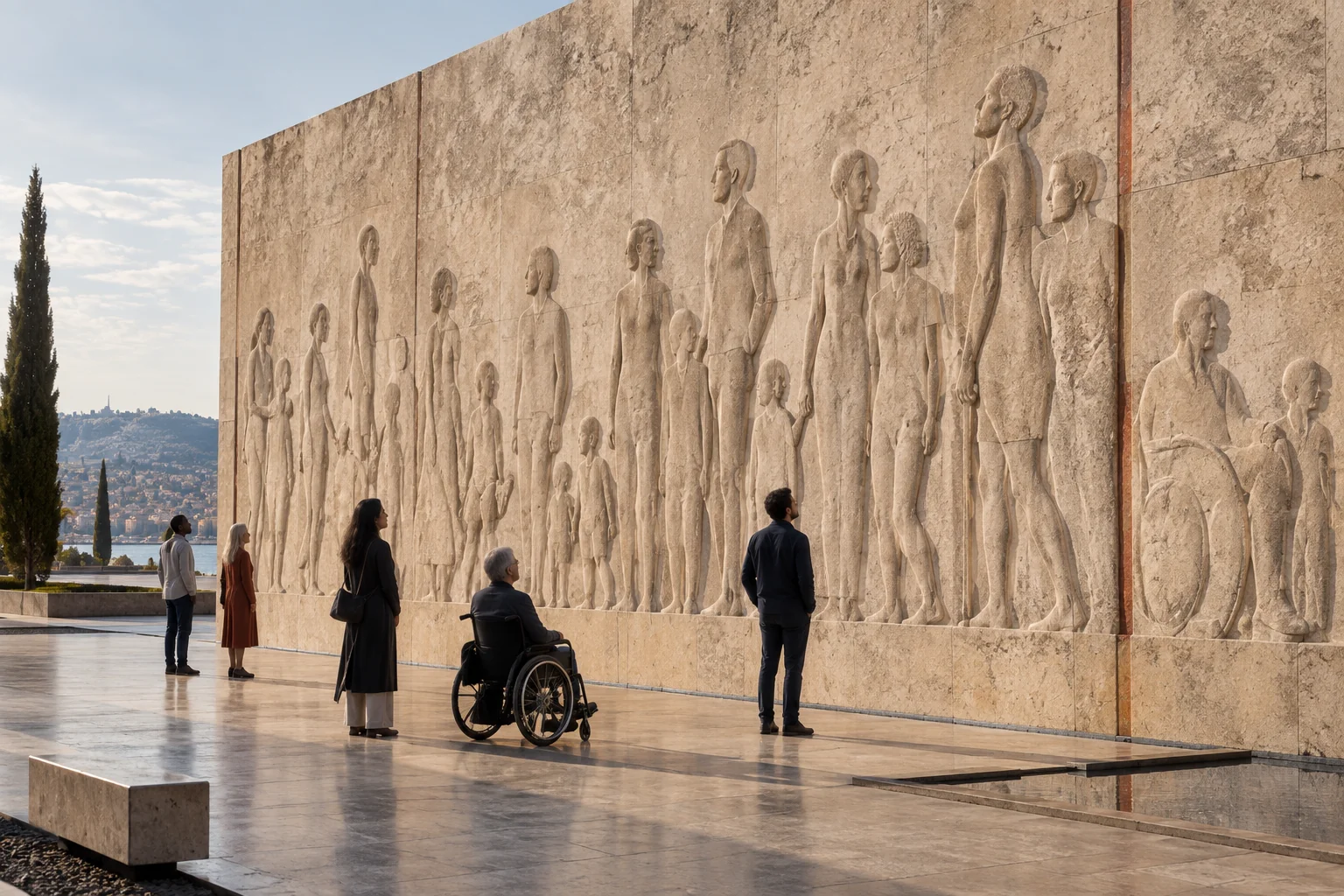
An immense limestone relief of distinct human silhouettes opens onto a sunlit public square.
The measure of a lifeOriginal visual study · AI-generated

$2.5T Annual Map

A whole-life public-benefit portfolio.

This is an illustrative starting architecture, not a final appropriation. Percentages are a transparent planning baseline and would move only through public evidence, capacity findings, and resident review—never lobbying pressure.

$2.5 trillion100% restricted to public benefit

Select a portfolio to read the immediate work and long-term purpose.

01

Health & care

$600B 24%

Act now. Medical-debt relief, primary and mental-health access, essential medicines, rural care, dental care, and clinical home- and community-based services.

Build for twenty years. Build a prevention-first, disability-inclusive care system with enough clinicians, caregivers, public-health capacity, and resilient supply.

02

Homes & community stability

$450B 18%

Act now. Eviction prevention, rental relief, rapid rehousing, supportive housing, accessible home modifications, and secure tenure.

Build for twenty years. Acquire, preserve, and build permanently affordable homes near opportunity while repairing neighborhoods without displacing residents.

03

Education & lifelong learning

$375B 15%

Act now. Early learning, tutoring, educator support, special education, educational libraries, community college, skills, and targeted student-debt relief.

Build for twenty years. Create a cradle-to-late-life public learning system that widens capability, civic understanding, and economic freedom.

04

Mobility & universal access

$275B 11%

Act now. Reliable transit, paratransit, safer streets, rural mobility, station accessibility, fare relief, and repair of dangerous routes.

Build for twenty years. Make every community navigable without requiring wealth, a car, perfect mobility, sight, hearing, or digital fluency.

05

Food, water & essential security

$250B 10%

Act now. School meals, food-benefit supplements, safe-water interventions, community food hubs, and emergency energy support.

Build for twenty years. Rebuild regional food, water, and energy resilience so basic security survives price shocks, disasters, and supply failure.

06

Caregiving & household security

$200B 8%

Act now. Childcare, paid-care bridges, nonclinical elder and disability supports, emergency cash, benefits navigation, and relief from predatory household debt.

Build for twenty years. Recognize care as essential infrastructure and give households enough stability to plan, work, learn, participate, and recover.

07

Civic power, justice & public knowledge

$150B 6%

Act now. Civic education, libraries, legal aid, language access, voting access, community media, public meetings, and resident-led planning.

Build for twenty years. Give people practical knowledge, time, tools, representation, and trustworthy institutions through which to shape public life.

08

Digital public-interest infrastructure

$100B 4%

Act now. Affordable broadband, devices, accessible digital services, cybersecurity for frontline institutions, and human help for offline access.

Build for twenty years. Build interoperable, privacy-preserving public technology that can be audited, appealed, repaired, and used by everyone.

09

Local resilience & adaptive reserve

$75B 3%

Act now. Locally chosen repairs, disaster recovery, heat and climate protection, and rapid response to needs national formulas miss.

Build for twenty years. Let communities adapt the compact to place while preserving national rights, transparency, and public-benefit rules.

10

Integrity, measurement & redress

$25B 1%

Act now. Prepayment controls, open contracting, audits, resident ombuds services, secure reporting, investigations, recovery, and appeals.

Build for twenty years. Make public proof, independent scrutiny, beneficiary voice, and continuous repair part of the fund—not an afterthought.

Accessibility is not one line item. Every portfolio must meet universal-design, language-access, geographic-equity, and meaningful-participation requirements. The mobility allocation accelerates access; the civil-rights covenant governs the entire fund.

Sector envelopes include delivery administration, staffing and maintenance. The $25B integrity line funds independent oversight. “100% public benefit” includes these necessary costs; it does not mean every dollar is a cash transfer. Each expense has one primary account, with nonfinancial tags for shared outcomes.

What success would mean

Judge the gift by the life it makes possible.

Set costed local targets after an independent baseline. Compare access, quality and affordability across places and groups, then publish progress and shortfalls. These are proposed measures, not results already achieved.

01

Care within reach

Measure unmet care, appointment delays, medicine availability, avoidable hospital use and household medical burden.

02

A secure place to live

Track housing stability, time without shelter, affordability, accessibility and displacement after neighborhood investment.

03

Learning that opens choices

Assess learning, completion, debt burden and routes into skilled work, with results for learners who face the greatest barriers.

04

Time and freedom in daily life

Track reliable journeys, care availability, food and water security, household costs and essential-service continuity through disasters.

05

A meaningful public voice

Measure accessible participation, resolved complaints and effective remedies. Publish privacy-protected independent evaluations and their limits.

No national coverage target is claimed before independent costing. Count a person once in total reach, even when they use several services; report service episodes separately.

From relief to lasting capacity

How It Reaches People

Fast enough for today. Strong enough for a generation.

The compact separates the beneficiary from the delivery partner. Government, nonprofit, cooperative, public institution, and mission-locked private providers may deliver a benefit; none may redirect the money away from that benefit.

  1. 01

    Relief reaches people first.

    Direct benefits, automatic enrollment, debt relief, vouchers controlled by residents, and reimbursement for verified care or services reduce delay and administrative burden.

  2. 02

    Capacity grows beside relief.

    Clinics, schools, transit operators, housing stewards, libraries, legal-aid organizations, food systems, and care workforces receive mission-locked support tied to access.

  3. 03

    Money follows a public outcome.

    A public agency may deliver a service, but no payment becomes unrestricted government revenue. Dollars follow a person, an accessible service, or a certified public asset.

  4. 04

    Proof remains public.

    Awards, owners, subawards, prices, milestones, outcomes, audits, conflicts, enforcement actions, and appeals are published in accessible, privacy-protective formats.

Public-benefit boundary

What the fund will never pay for.

  • Unrestricted deposits into a federal, state, local, or territorial treasury
  • Weapons, surveillance, or expansion of punitive incarceration
  • Corporate bailouts, dividends, stock buybacks, private-equity extraction, or speculative land banking
  • Campaigns, parties, candidate activity, lobbying, donor privileges, naming purchases, or personal promotion
  • Discriminatory systems, inaccessible services, union busting, retaliation, self-dealing, or related-party enrichment
  • Permanent proprietary control over infrastructure that the public paid to create

Innovation & shared opportunity

Build the future here. Let everyone share in it.

Public investment should give scientists, builders, technicians, caregivers, educators, and entrepreneurs the means to solve hard problems—and make sure the gains reach every community, not only the people who already own the future.

Research · Skilled work · Clean energy · Shared prosperity

The Public-Benefit Compact

The gift is generous. The conditions are uncompromising.

Participation is voluntary. Acceptance means accepting a clear, public covenant that protects government responsibility, civil rights, honest delivery, and the long-term fiscal future.

Condition 01

Supplement. Never substitute.

Federal, state, territorial, Tribal, and local covered spending—excluding this fund—must remain at or above a rolling three-year baseline adjusted for inflation, population, and eligible caseload.

  • No rescission, delayed appropriation, tax-credit swap, or category relabeling
  • No counting the fund, private matching money, or emergency relief toward the floor
  • Program-by-program and consolidated certification, with public reconciliation tables
Condition 02

Put public debt on a real downward path.

The federal government must adopt and maintain an independently scored path that reduces debt held by the public as a share of GDP across each rolling five-year window. CBO currently calls the trajectory unsustainable.[1]

  • Use debt-to-GDP and primary-balance measures, not cosmetic nominal-dollar claims
  • Narrow, time-limited exceptions for war, declared disaster, pandemic, or severe recession
  • Missed windows require a published cure plan before government-linked expansion resumes
Condition 03

Civil rights are a floor, not a slogan.

Every institutional grantee and delivery partner signs a contractual equality covenant at least as protective as applicable civil-rights law, including Title VI and disability-access requirements.[10][11]

  • No exclusion by race, color, national origin, Tribal affiliation, religion, sex, sexual orientation, gender identity, disability, age, family status, language, veteran status, or other protected status
  • Universal design, effective communication, reasonable modification, language access, and offline access
  • Independent complaints, testing, corrective action, remedies, and anti-retaliation protection
Condition 04

Prevent corruption before payment.

GAO estimates federal fraud losses at $233–$521 billion annually using 2018–2022 data.[9] The fund therefore begins with preventive controls, not a “pay and chase” model.

  • Beneficial-ownership, conflict, related-party, exclusion, price, and duplicate-benefit checks
  • Open awards and subawards, independent audits, protected whistleblowers, random inspection, and data analytics
  • Automatic clawback, debarment, restitution, and referral for material fraud or knowing misuse
Conditions bind institutions—not people in need.

A breach pauses the affected channel, office, contractor, or expansion. Essential food, shelter, medical, disability, and safety benefits continue through a clean direct or independent route while the institution cures the breach. Launch requires legally available resources for protected service obligations and prequalified alternative delivery routes. A federal fiscal condition cannot be passed down as a penalty on a resident or an unrelated local provider. No benefit depends on party, political belief, civic participation or support for the Foundation’s One World vision.

Culture & participation

More people able to create, learn, and belong.

A thriving America needs more than survival. It needs libraries, arts, music, gathering places, local traditions, many languages, and the time and security to participate in culture rather than experience it as a luxury.

Arts · Libraries · Community spaces · Lifelong learning

Conditions for releasing funds

Annual Release Gate

No blank checks. No hidden ledgers. No irreversible harm.

Each fixed $2.5 trillion annual contribution supports a sequence of reviewable, capacity-tested releases. Unused or paused amounts remain committed to future public benefit; they do not revert to government, contractors, or the donor. Report contributions received, legal commitments, cash paid and verified services separately. Retained receipts may finance later releases above one annual installment, subject to funded obligations, liquidity and public approval. A receipt is never reported as an outcome.

  1. 01

    Publish the baseline

    Covered public spending, debt measures, rights compliance, market capacity, unit costs, and prior-year outcomes are published before a tranche is approved.

  2. 02

    Certify independently

    Separate fiscal, civil-rights, accessibility, procurement, and fraud-risk reviewers sign public certifications. No recipient certifies itself.

  3. 03

    Release quarterly

    Annual funding is divided into staged releases, with early money weighted toward immediate relief and capacity expansion where supply is demonstrably constrained.

  4. 04

    Trace every award

    Beneficial ownership, related parties, prices, subcontractors, milestones, geographic distribution, and beneficiary outcomes are visible before the next release.

  5. 05

    Pause, cure, recover

    Material breach triggers a targeted pause, protected reporting, investigation, correction, restitution, clawback, debarment, and referral where law requires it.

The twenty-year pathway

American Vision · The 20-Year Arc

Relief is the beginning. Durable freedom is the finish.

The sequence protects urgency without mistaking emergency spending for transformation. Every phase keeps immediate public benefit alive while shifting more weight toward capacity, prevention, and permanence. These are program years, beginning after funding and legal readiness. Construction and services may continue beyond the final contribution only with ring-fenced funding and an accountable operator; year twenty is not an automatic end to essential care.

Years 1–2 Stabilize

Stop avoidable loss: medical and household debt, hunger, eviction, untreated illness, inaccessible services, and urgent repair.

Years 3–7 Build capacity

Train and retain workers, expand clinics and care, preserve homes, grow transit service, modernize schools, and strengthen local delivery.

Years 8–14 Reinvent systems

Replace fragmented access with interoperable, rights-protecting systems designed around whole lives and measurable public value.

Years 15–20 Make it durable

Lock in affordability, public stewardship, maintenance, workforce pipelines, fiscal responsibility, and institutions able to improve without the gift.

Public participation

A future built with the people who will live it.

Participation is part of the infrastructure: residents help shape priorities, test access, examine results, and hold every institution to the public promise—in person, online, and in the languages their communities use.

Teach civic knowledge, critical reasoning and competing perspectives. Protect the freedom to disagree. Independent educators evaluate learning and access, never political loyalty.

Governance Without Capture

No officeholder, donor, contractor, or institution controls the gift alone.

The proposed vehicle is an independently governed, mission-locked public-benefit trust. The founder protects the irrevocable purpose of the gift but may not extract value, direct money to personal interests, or override the integrity and rights systems.

Government participates by maintaining effort, meeting fiscal and rights conditions, opening data, and delivering eligible benefits—not by owning the fund.

01

Independent trustees

Staggered terms, financial and political conflict limits, public reasons for decisions, and removal for cause.

02

Resident assembly

A compensated, rotating civic-lottery body, stratified for geography and lived experience, reviews priorities and distribution.

03

Rights & accessibility council

People protected by the covenant help design access standards, test delivery, and trigger independent review.

04

Integrity office

Independent audit, investigation, procurement review, protected reporting, recovery authority, and public enforcement reports.

05

Public ledger

Machine-readable and human-readable awards, subawards, owners, prices, geography, milestones, outcomes, and audit status.

06

Appeal & remedy

People can challenge denial, inaccessibility, discrimination, data error, or misuse—and receive a timely, reasoned decision.

Evidence & Limits

Built from public evidence. Presented with honest boundaries.

Evidence updated September 21, 2026, including the latest Census, HUD and Federal Student Aid releases. Different datasets use different reference periods, definitions, and methods. The figures explain need and guardrail design; they do not prove that a particular allocation is optimal.

  1. 01

    Congressional Budget Office

    Director’s Statement on the Budget and Economic Outlook: 2026 to 2036 CBO projects debt held by the public rising from 99% of GDP at the end of 2025 to 120% in 2036 and describes the fiscal trajectory as unsustainable.
  2. 02

    Centers for Medicare & Medicaid Services

    National Health Expenditure Fact Sheet U.S. health spending reached $5.3 trillion in 2024, or $15,474 per person and 18.0% of GDP.
  3. 03

    U.S. Census Bureau

    Health Insurance Coverage in the United States: 2025 An estimated 26.7 million people, or 7.9% of the population, were uninsured throughout 2025. The change from 2024 was not statistically significant.
  4. 04

    U.S. Department of Housing and Urban Development

    2025 Annual Homelessness Assessment Report: HUD release HUD counted 745,652 people experiencing homelessness on a single night in January 2025. This point-in-time estimate does not count everyone who experiences homelessness during a year.
  5. 05

    U.S. Department of Agriculture, Economic Research Service

    Household Food Security in the United States in 2024 In 2024, 13.7% of U.S. households—18.3 million households—experienced food insecurity.
  6. 06

    Centers for Disease Control and Prevention

    CDC Data Shows Over 70 Million U.S. Adults Reported Having a Disability More than one in four U.S. adults reported a disability in 2022.
  7. 07

    Federal Student Aid

    Federal Student Aid Posts Updated Reports to FSA Data Center As of March 31, 2026, 42.6 million recipients held $1.7 trillion in outstanding federal student loans.
  8. 08

    National Assessment of Educational Progress

    2022 Civics Achievement-Level Results Twenty-two percent of eighth-grade students performed at or above NAEP Proficient in civics.
  9. 09

    U.S. Government Accountability Office

    Program Integrity: Improper Payments and Fraud Risks GAO estimated $233 billion to $521 billion in direct annual federal fraud losses using fiscal-year 2018–2022 data.
  10. 10

    U.S. Department of Justice, Civil Rights Division

    Title VI Legal Manual: Defining Title VI Title VI bars discrimination based on race, color, or national origin in programs receiving federal financial assistance.
  11. 11

    U.S. Department of Justice

    ADA Title II: State and Local Governments Title II requires equal opportunity, effective communication, reasonable modifications, and program access for people with disabilities.
  12. 12

    PubMed

    Social determinants of health and U.S. cancer screening interventions A 2023 systematic review connects social determinants with persistent screening inequities and examines multilevel interventions.
  13. 13

    PubMed

    American health care paradox—high spending on health care and poor health A review of cross-national evidence argues that social, behavioral, and environmental investment is relevant to health outcomes.

Implementation status

This page states a proposed founding commitment and operating architecture. It is not a representation that $50 trillion is presently capitalized or available, and it is not a grant offer, appropriation, contract, investment prospectus, tax opinion, or legal advice. A binding launch would require verified capitalization, fiduciary and tax design, independent governance, statutory and contractual agreements, macroeconomic capacity planning, detailed eligibility rules, privacy safeguards, and enforceable remedies. Program year one begins only after those gates are met; no calendar launch date is claimed.

Visual study. Imagined architecture, not a funded project or Foundation facility. About the artwork.

A tall public library joins deep walnut shelves with warm stone and a narrow view of the sky.
Knowledge across a lifetimeOriginal visual study · AI-generated
Contribute to American Vision