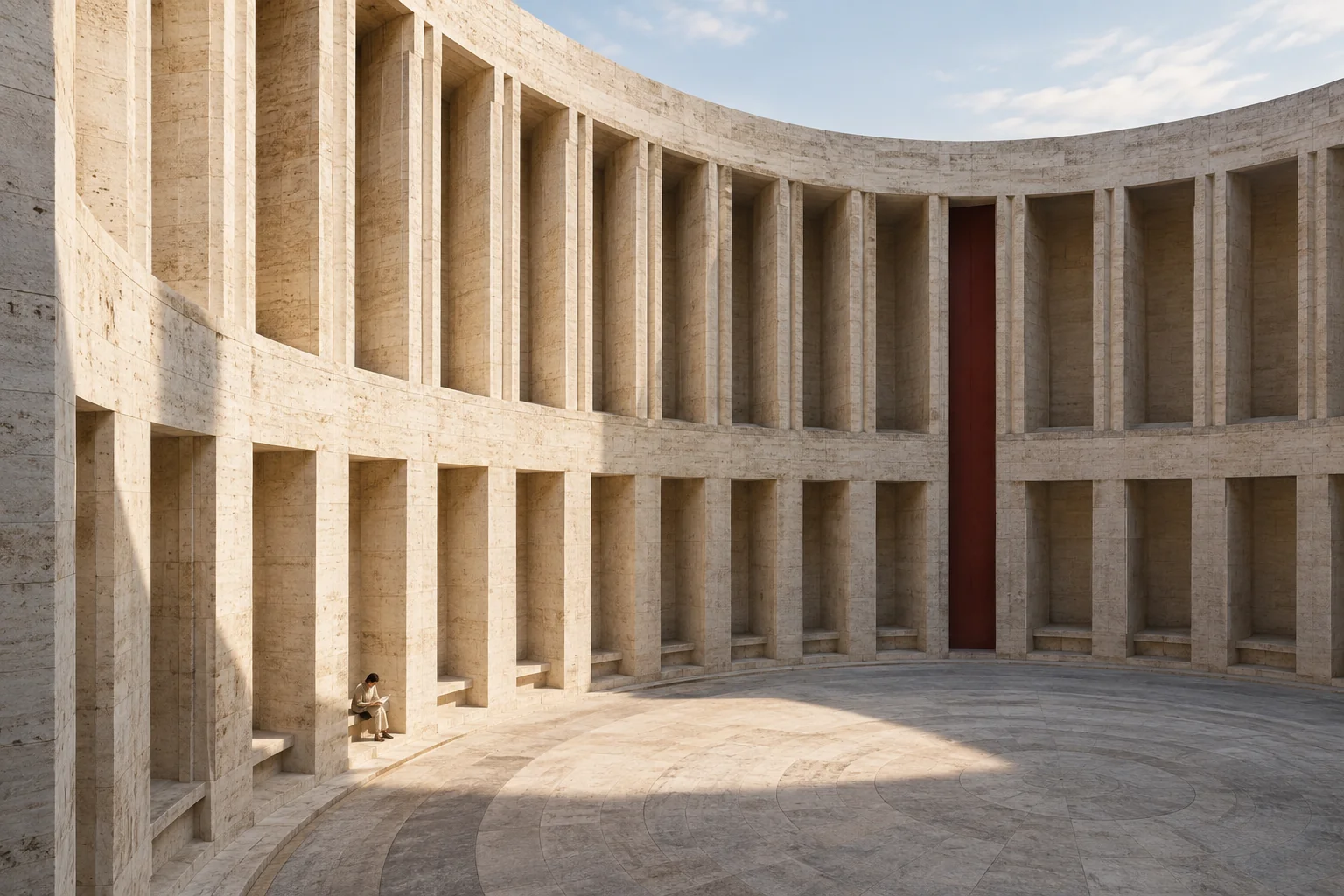
A circular stone reading cloister with deep alcoves, a red doorway, and a solitary reader.
A place for knowledgeOriginal visual study · AI-generated

Our focus / Education

The freedom to learn.

Learning should open possibilities at every age, and keep the door open when life interrupts.

Explore the agenda

A right to begin again.

Education should not sort people once and follow them forever. It should keep restoring agency, curiosity, belonging, and the practical power to choose again.

A person’s education does not end at a school gate or a first qualification. Work changes. Families move. Caregiving, disability and financial pressure interrupt plans. A public learning system should recognize what people already know, make new learning possible and leave room for curiosity that has no immediate economic return. Our proposed agenda connects these individual pathways to the places and people that sustain them.

Research & proposal stage. No current grants, funded partnerships or service delivery are claimed.

Ascending limestone planes meet a translucent green glass slab in an original imagined architectural sculpture.
An open ascentOriginal sculptural study · AI-generated

Every stage should open another.

An open sequence of stone planes gives this study its structure. Learning, too, needs routes between stages: from discovery to confidence, from interruption to return, and from acquired knowledge to the freedom to use it.

The proposed next chapter

Make learning possible in real life.

The next work would examine the conditions that help someone arrive, participate, learn and return. Access continues long after admission.

The door is open only if a person can walk through it.

Priorities for development
01

Keep learning places usable

Heat, unsafe buildings, unreliable utilities and inaccessible transport can interrupt the relationships on which learning depends.

Proposed work

Develop locally costed resilience plans for schools and public learning spaces. Protect instruction, meals, disability support and educator contact together, with alternatives that work when connectivity does not.

What we would measure

Lost learning days, reach of recovery support and continuity for learners who disappear from enrolment records. A reopened building is not proof that everyone has returned.

02

Make returning a real option

Fees are only one obstacle for adults balancing work, care and study. Previous learning can be lost between institutions.

Proposed work

Design re-entry pathways with transparent total costs, flexible schedules, guidance and recognition of prior learning. Map the journey from first enquiry to a recognized achievement.

What we would measure

Participation, demonstrated learning, recognized credit and household financial strain separately. Completion should not conceal unmanageable debt or unpaid care burdens.

03

Put educators in the design room

A new platform can increase workload and costs without strengthening the learning relationship.

Proposed work

Develop an open-resource and procurement framework with educators and learners. Require accessible materials, offline alternatives, transparent data practices and a plan to maintain the resource after launch.

What we would measure

Learning outcomes, teacher workload, privacy, accessibility and full maintenance costs. Engagement statistics cannot substitute for demonstrated capability.

Learning as public infrastructure.

Education is the architecture through which societies transmit capability, belonging, critical judgment, and imagination. True Tomorrow treats education as lifelong public infrastructure, not a narrow credential market.

Climate-Ready Learning Places

Treat continuity plans, healthy buildings, heat resilience, reliable utilities, transportation, meals, and digital access as parts of the learning environment.

Proposed outputMinimum standard · vulnerability map · continuity plan

Public Learning Commons

Connect schools, libraries, museums, community organizations, open knowledge, and digital public infrastructure into one lifelong civic resource.

Proposed outputCommons charter · shared catalog · access pathway

Educator Power

Invest in time, preparation, professional trust, peer learning, and tools that strengthen educators instead of routing around them.

Proposed outputPractice network · protected time · evidence toolkit

Debt-Free Pathways

Design public options, transparent costs, portable credit, debt relief, and re-entry routes that expand mobility instead of narrowing it.

Proposed outputAffordability compact · re-entry map · learner protections

Begin with an interrupted pathway.

Advance when the conditions are met. These are proposed stages, not announced projects or deadlines.

  1. Understand

    Find the barriers

    Work with learners and educators to trace one route that people struggle to complete. Include those who never enrol and those whose previous achievements are unrecognized.

  2. Develop

    Design the return

    Specify time, guidance, accessible materials, educator capacity and affordability. Publish options and tradeoffs before choosing a delivery model.

  3. Review

    Learn from the attempt

    Review learning, belonging and financial strain together. A future pilot should publish who benefited, who remained excluded and what must change before expansion.

Credentials, attendance and platform use are useful signals, but none is sufficient evidence of learning. Evaluation should respect language, culture, disability and the purpose of the pathway.

Seven upright limestone leaves fan around a shared bronze binding.
Leaves of knowledgeOriginal sculpture · Blender

Education depends on sustained attention, professional trust and places where people belong.

Capability, not just participation.

A useful learning system is judged by what people can understand, do, question and choose, as well as whether they can remain in it.

Continuity
How much learning is lost to disruption, and whose recovery support actually arrives?
Capability
Can learners demonstrate understanding and apply knowledge beyond a single assessment?
Agency
Are people able to change direction, transfer prior learning and return without penalty?
Conditions
Do educators have preparation time, usable tools and support for varied learner needs?

Proposed measures, not reported outcomes. Baselines, targets and methods would be agreed with participating communities before any pilot.

Keep ambition accountable.

How the work would be developed, and what it must protect.

Our approach

  1. Listen to learners

    Begin with the barriers, aspirations, languages, responsibilities, and prior knowledge people actually bring.

  2. Design the conditions

    Treat time, place, care, safety, access, materials, and educator capacity as part of learning design.

  3. Strengthen the adults

    Equip and trust educators, librarians, mentors, and families as a connected learning ecosystem.

  4. Keep the door open

    Build credit, finance, guidance, and public options so a changed life does not end a person's learning life.

Policy agenda

The policy agenda connects educator capacity, accessible and climate-ready facilities, public digital infrastructure, disability and language access, transparent outcomes, debt protection, and meaningful routes back into learning.

The Enlightenment Act

Technology serves relationship

Tools should expand what learners and educators can do together, not substitute automation for attention, trust, or professional judgment.

Learning data is not a commodity

Students should not have to surrender a permanent behavioral profile in exchange for public education.

Access continues after admission

Formal entry means little without usable materials, language support, disability access, food, transport, time, and care.

Many routes can be excellent

A strong system supports academic, technical, civic, creative, and experiential learning without assigning dignity by prestige.

Further reading

Ask what makes learning last.

Foundation evidence brief

Classrooms That Withstand the Climate

A sourced evidence brief on protecting learning continuity through resilient places, regional finance, and support for the learning relationship itself.

In-depth publicationEducation Pathways to 2050
Open research questions
  1. Which learning models improve agency rather than only test performance?
  2. How can education finance protect students from long-term economic drag?
  3. What should public education guarantee in an age of automation and artificial intelligence?

Grounded in public evidence

UNESCO’s lifelong-learning and technology work informs these proposed priorities. Local educators and learners would determine the appropriate model and evaluation.

UNESCO · Marrakech Framework UNESCO · Technology in education

Bring a pathway worth opening.

We welcome evidence from learners, educators, librarians and public institutions about interrupted learning, resilient places and routes back into education.

Contribute to the work