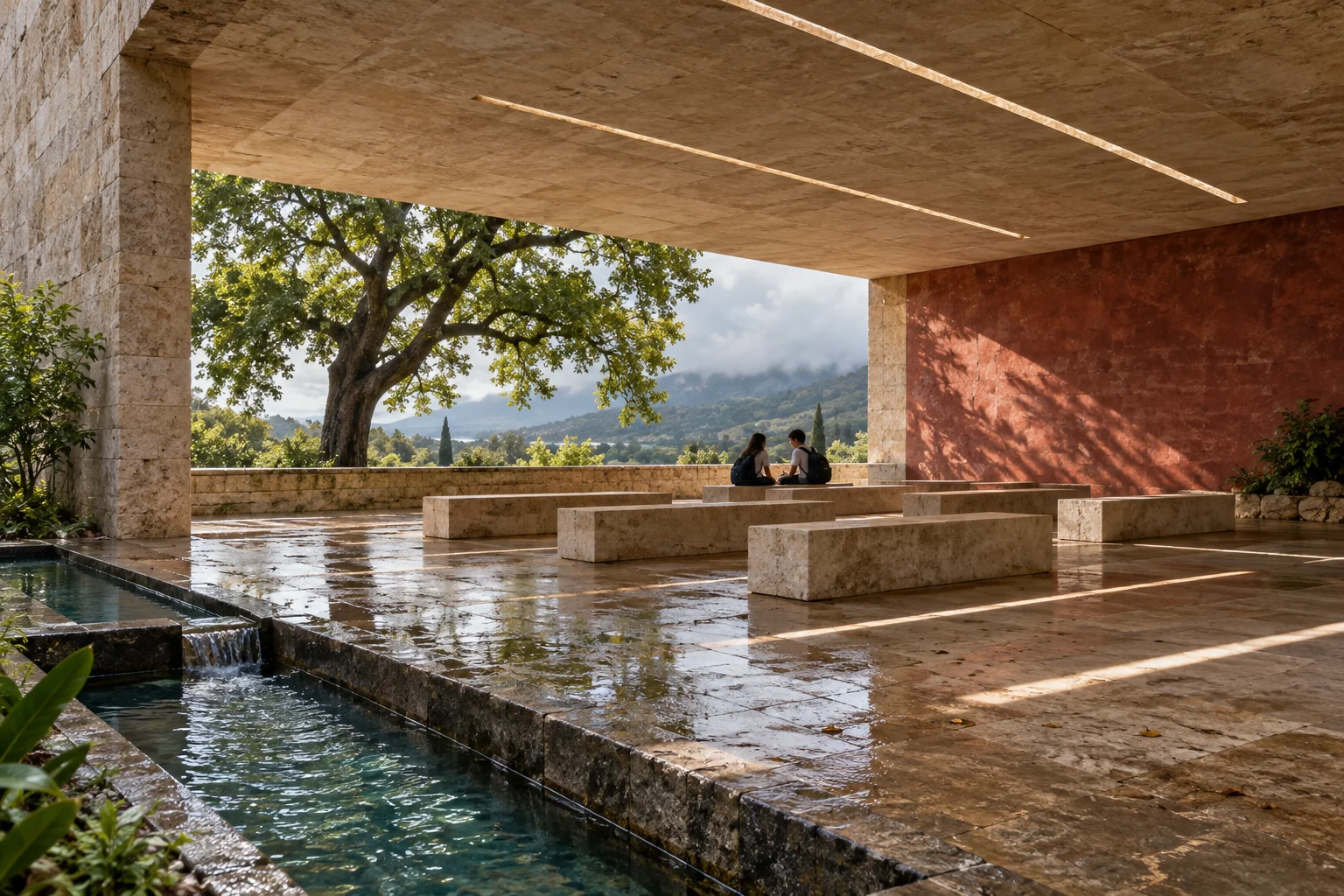
Classrooms That Withstand the Climate

Classrooms That Withstand the Climate

Keeping learning safe, continuous, and humane through climate shocks. A global evidence synthesis connecting school design, thermal safety, continuity planning, teacher support, public health, and climate finance so learning can continue through disruption.

The Climate ClassroomOriginal visual study · AI-generated

Research Question

Which affordable infrastructure, scheduling, continuity, financing, and curriculum interventions best protect learning and student well-being during heat, floods, storms, drought, and displacement?

Publication
Evidence Brief
Published
Pillar
Education
Evidence base
4 primary sources
Review status
Foundation synthesis; not peer reviewed
Executive synthesis

Climate disruption is already an education-system condition, not a distant scenario. Heat, storms, floods, drought, wildfire, and displacement interrupt attendance, damage facilities, strain teachers, and worsen existing inequality. Reopening a building is not the same as restoring learning, health, safety, or trust.

Resilience should be designed across four connected layers: safe facilities and operations; learning-continuity plans; prepared and supported educators; and community systems able to reach children who are displaced, disconnected, or otherwise excluded. Climate education matters, but it cannot substitute for climate-ready institutions.

Findings

What the evidence supports.

Source markers link findings to the evidence below.

01

Disruption is already global and recurrent

UNICEF estimated that at least 242 million students in 85 countries or territories experienced climate-related school disruption in 2024. Heatwaves alone affected an estimated 171 million students, making thermal safety and scheduling core education issues. [1]

02

The burden follows existing inequality

Seventy-four percent of students affected in UNICEF's 2024 snapshot were in low- and lower-middle-income countries. World Bank analysis found low-income countries losing about 18 school days annually to climate shocks, compared with 2.4 days in wealthier countries. Resilience funding should therefore be weighted toward vulnerability, not distributed evenly per building. [1] [2]

03

A resilient school is more than a resilient structure

UNESCO's green-school quality standard organizes action across governance, facilities and operations, teaching and learning, and community engagement. This supports a whole-system standard that joins physical adaptation with decision rights, curriculum, and local coordination. [3]

04

Regional investment cases are promising, but not automatically transferable

UNICEF's 2026 Eastern and Southern Africa analysis estimates large lifetime-income losses from disrupted learning and benefit-cost ratios of 2:1 to 13:1 for investments in climate-resilient education infrastructure. The direction is important, but cost and benefit assumptions must be re-estimated locally before use in budgets. [4]

Institutional Implications

What this changes in practice.

These are design implications drawn from the synthesis, not claims that one institutional model will fit every jurisdiction.

01

Set a minimum climate-ready school standard

The standard should cover heat, air quality, water and sanitation, drainage, safe shelter, accessibility, power and communications, and continuity plans—scaled to local hazards and maintained through public reporting.

02

Protect the learning relationship

Continuity plans should preserve contact between learners and trusted educators, provide low-bandwidth and offline options, include psychosocial support, and avoid shifting uncompensated emergency work onto teachers and families.

03

Finance vulnerability before damage

Capital formulas should combine facility condition, hazard exposure, poverty, disability access, displacement risk, and the fiscal capacity of the responsible authority. Emergency repair funds alone reward response while underfunding prevention.

Research Programme

What the foundation should test next.

  1. Develop a school-level risk and readiness protocol that communities can validate without publishing sensitive child or facility-security data.
  2. Compare passive cooling, schedule changes, air-quality measures, and energy retrofits by total cost, health effect, learning continuity, and maintenance burden.
  3. Pilot a continuity compact among schools, health services, transit, emergency management, and community organizations, with specific duties before and after a disruption.

Method & Limits

How to read this brief.

Method

This rapid evidence brief synthesizes recent global and regional evidence from UNICEF, UNESCO, and the World Bank. It prioritizes sources that state their scope and provide actionable system-design implications. Estimates from regional investment cases are presented as source findings rather than universal forecasts.

Limitations

School-closure data are incomplete and can undercount short, local, or unreported disruptions. Days closed do not capture reduced instructional quality, health effects, or unequal recovery. Regional cost-benefit estimates depend on modelling assumptions and should not be transferred to another jurisdiction without local hazard, cost, demographic, and education data.

Source Record

Read the official sources.

  1. [1]

    UNICEF · January 2025

    Learning Interrupted: Global snapshot of climate-related school disruptions in 2024

    Global snapshot of climate hazards and school disruption.

  2. [2]

    World Bank · 4 September 2024

    Education for Climate Action: 400 million students affected by climate-related school closures

    Cross-country closure and school-adaptation findings.

  3. [3]

    UNESCO · 3 June 2024

    Green school quality standard: Greening every learning environment

    Whole-school framework for governance, facilities, learning, and community engagement.

  4. [4]

    UNICEF · April 2026

    Protecting Children's Learning Futures

    Regional evidence and investment modelling for Eastern and Southern Africa.

Suggested citation: True Tomorrow Foundation (2026). Classrooms That Withstand the Climate. Evidence Brief. Reviewed July 17, 2026.

Related reading